ReMix and RE:Mastering trial
– ArtXTech
After a fair few ups and downs, I finally wrapped up my final audio analysis report and finished the second semester of uni for 2025.
Now that we’re past mid-December, the festive season is well and truly here. Since I’m living the quiet life on my own, I thought I’d finally crack on with the projects I’ve been putting off. I’ve had to sideline my Remotion motion design work because of post-grad, not to mention the backlog of YouTube scripts I need to produce and the vocal mixing for my new mic that’s been sitting there waiting for a red-hot go.
Up until now, I’ve mostly been using my DAW skills for audio analysis and beat-trigger timing, which left me feeling a bit parched creatively. I’ve been craving actual composition, production, and remastering. It’s reached the point where I’m starting to ask some pretty fundamental questions about texture and how a musical piece is actually put together.
Lately, I’ve been flogging Saja Boys’ Your Idol and Plave’s Rizz and Chroma Drift on repeat, but I couldn’t help feeling they were missing a little something.
As you lot know, even though I’m an Aussie citizen, I’m a first-gen migrant who grew up in Korea until I was an adult. There’s no denying that the core of my identity, my sensibilities, and the way I perceive the world is Korean through and through. Having grown up listening to all sorts of genres in Korea, I’ve watched the evolution of K-pop from the first to the third generation right there on the ground. And it wasn’t just the idols—I was always following the underground scenes in places like Hongdae, keeping tabs on artists who were quietly doing their thing. My emotional foundation was built on rock ballads and that unique melodic alternative sound typical of Korean bands—the stuff that ruled before the current K-pop boom. It’s not that I hate the direction of modern K-pop, but…
It feels a bit “meh.”
Actually, no—it’s definitely a bit bland. That soulful style where singers would just belt out high notes at the climax has pretty much vanished. It’s been ages since we’ve seen artists like Sung Si-kyung, SG Wannabe, Naul, Kim Bum-soo, or Park Hyo-shin grace the MAMA stage. And back in the day, whether it was an idol group or a soloist, big year-end performances usually involved a live session band. Nowadays, that’s been replaced by a DJ or a sound engineer just hitting play on a backing track.
It’s just too quiet for my liking. At least to my ears.
So, I started mucking around in Logic Pro X to try my hand at some proper remastering and mixing.
The technical stuff—cutting and pasting, fades, cross-fading—I’ve done that a million times to build pre-processing datasets for my analysis work, so that was easy enough. But when it comes to the actual producer-side skills—changing textures to match a specific vibe, or dialling in the right spatial depth and delay—I really feel my lack of experience. I mean, it makes sense; I’ve never formally studied composition and my music theory is pretty shaky.
More than anything, I’m the type of learner who needs to get under the hood—writing code, breaking things, smashing them together, and rebuilding them—rather than just memorising theory. Unless someone hands me a perfectly organised project file and explains the theory simultaneously, it all feels a bit foreign. I mean, I wasn’t even a music major! If it weren’t for that bloody drum/bass rhythm game lighting a fire under me, I wouldn’t even be here…
Plave: Chroma Drift - Infusing City Pop Romance with the Raw Energy of a Live Gig
The first one I tried some reverb on was Plave’s Rizz. Logic Pro’s recent update made the Stem Splitter much better, so I used that to break the track down for mastering and then threw a few plugins at it.
My thoughts on the first attempt?
Far out, it sounds bloody amazing!
Since the original Chroma Drift already has that lush City Pop vibe, just getting the reverb and delay right made it sound top-notch. All I really did was boost the bass and add some compressor and distortion to the guitar amp. I gave the guitar distortion and clipping a fair dinkum nudge to sharpen the edges, then jumped on the master keyboard to play the MIDI chords myself and layer in some extra riffs. I even got stuck in and recorded some of my own bass and guitar parts to use as samples.
It ended up sounding like a proper live band playing the instrumental section backstage at a concert.
ONF – Bye My Monster
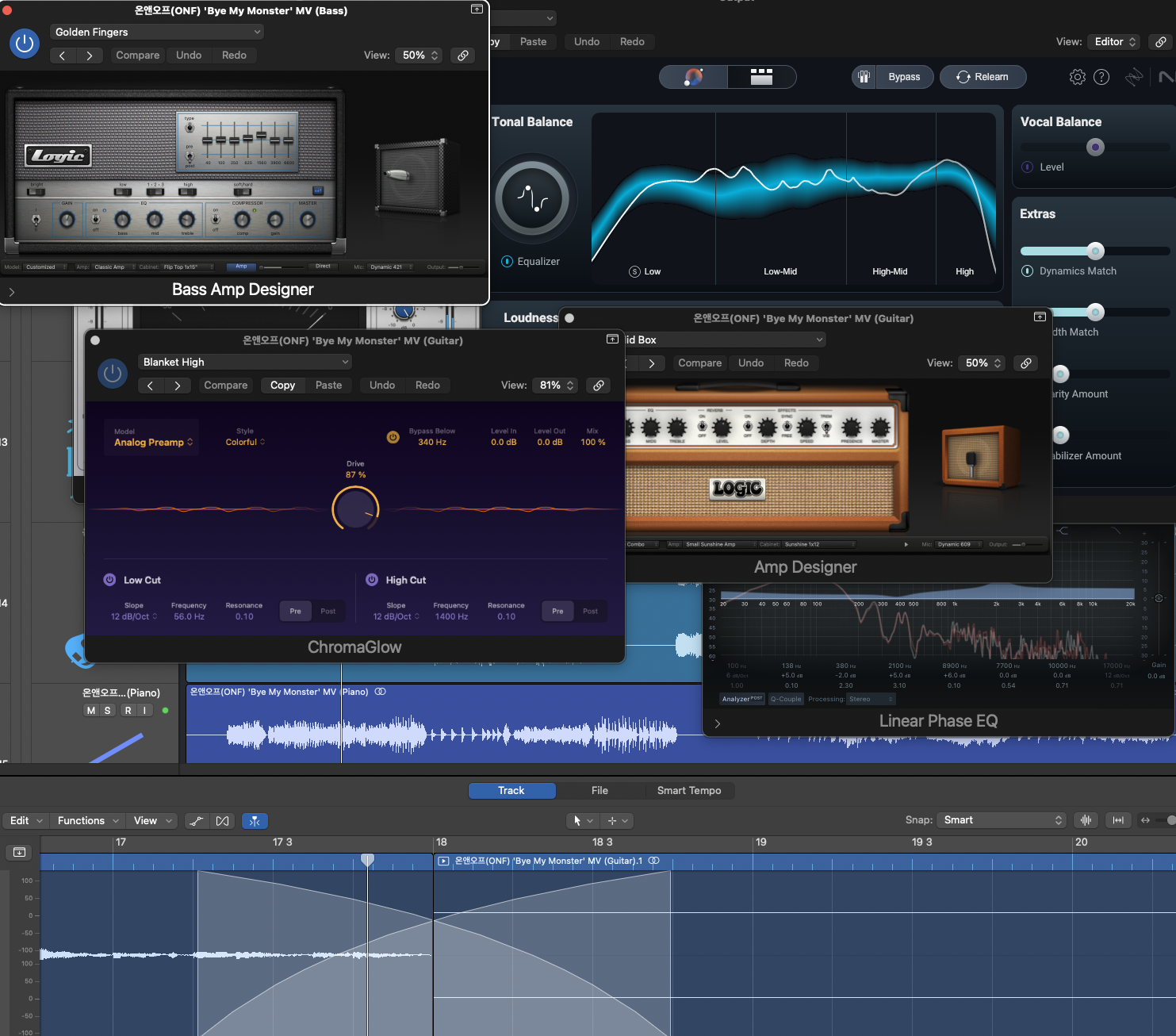
Released last year, ONF’s Bye My Monster is a lyrical track that samples classical music, with an intro that feels like a full live session. It’s packed with classic melodic soft rock ballad vibes. It’s been donkey’s years since I’ve heard this kind of lyrical production in K-pop. But the original studio version is designed for streaming—it’s polished to deliver the melody and verses clearly, so the interplay between the guitar, drums, and bass isn’t really highlighted. For a rock nerd like me, it still felt a bit thin.
For this track, which is already packed with those classic melodic soft rock elements, my goal was to crank up the synergy of the band’s live sound—the kind of raw energy that usually gets buried behind the squeaky-clean finish of a streaming version.
- Bass Amp Designer & ChromaGlow: I set up the bass using the Golden Fingers preset as my base. I blended in some Analog Preamp texture via ChromaGlow and cranked the Drive to push a sound that’s warm but still has a bit of a rough, gritty edge.
- Guitar & EQ Settings: I dialled in the guitar tone with the Amp Designer and used the Linear Phase EQ to carve out the unnecessary frequencies, really maxing out that specific sense of space you only get at a live venue.
- Vocal & Tonal Balance: I tweaked the Vocal Balance to make sure the vocals didn’t get drowned out by the heavy live session, and kept a close eye on the Tonal Balance Control overall to keep the band’s sound balanced right across the spectrum, from the deep lows to the crisp highs.
I went all in on this one. I recorded some of my own bass and guitar samples and mixed them into the split stems of the original. I used fades and cross-fades to blend my recordings with the original track, then slapped some EQ on top to maximise that “live band in a concert hall” texture.
Stray Kids – Go! Live (生)
This one was a bit of an experiment. Stray Kids are an interesting bunch. When I went to their concert, they had a full live band—drums, bass, keys, and guitar—blasting out this massive wall of sound while they did their high-intensity performance. But when you listen to the actual digital tracks, there’s hardly a trace of that band sound; it’s strictly EDM. It’s like they do entirely separate arrangements just for the live shows. Personally, I much prefer their rock versions, but when I sit down to think about how I’d rearrange their songs into rock, it’s hard to find a new angle. Most of the songs that would suit a rock vibe have already been officially released as rock remixes by the Skz boys themselves, haha.
So this time, I focused on the snare groove in Go! Live and experimented with some synth sampling, layering my own bits over the original keyboard lines. Working on the synth samples made me realise that this process feels a lot like algorithmic composition and electronic sound patterning.
- Vintage Tube EQ & Enveloper: I cranked the attack with the Enveloper to give those drum snares a proper bit of punch.
- I used the Vintage Tube EQ to add that classic vacuum tube harmonic saturation, making the whole sound feel nice and thick.
I reckon the highlight was messing about with my own experimental Synth sampling and layering it over the original keyboard lines. The whole process gave me this weirdly satisfying buzz, like I was putting together some complex “electronic acoustic pattern composition”. It honestly felt like I was deep-diving into “algorithmic pattern composition” while I was at it. Managing things like the Muddy Drum Loops while redesigning the whole electronic texture was heaps of fun.
This whole project has really sparked a new creative fire in me to get even more stuck into experimental electronic sounds next time.
Your Idol Saja Boys
I am now synthesising these technical skills into creative output. My recent work involves remixing K-Pop tracks to fit a retro-rock aesthetic, applying the signal processing knowledge I gained from my engineering days.
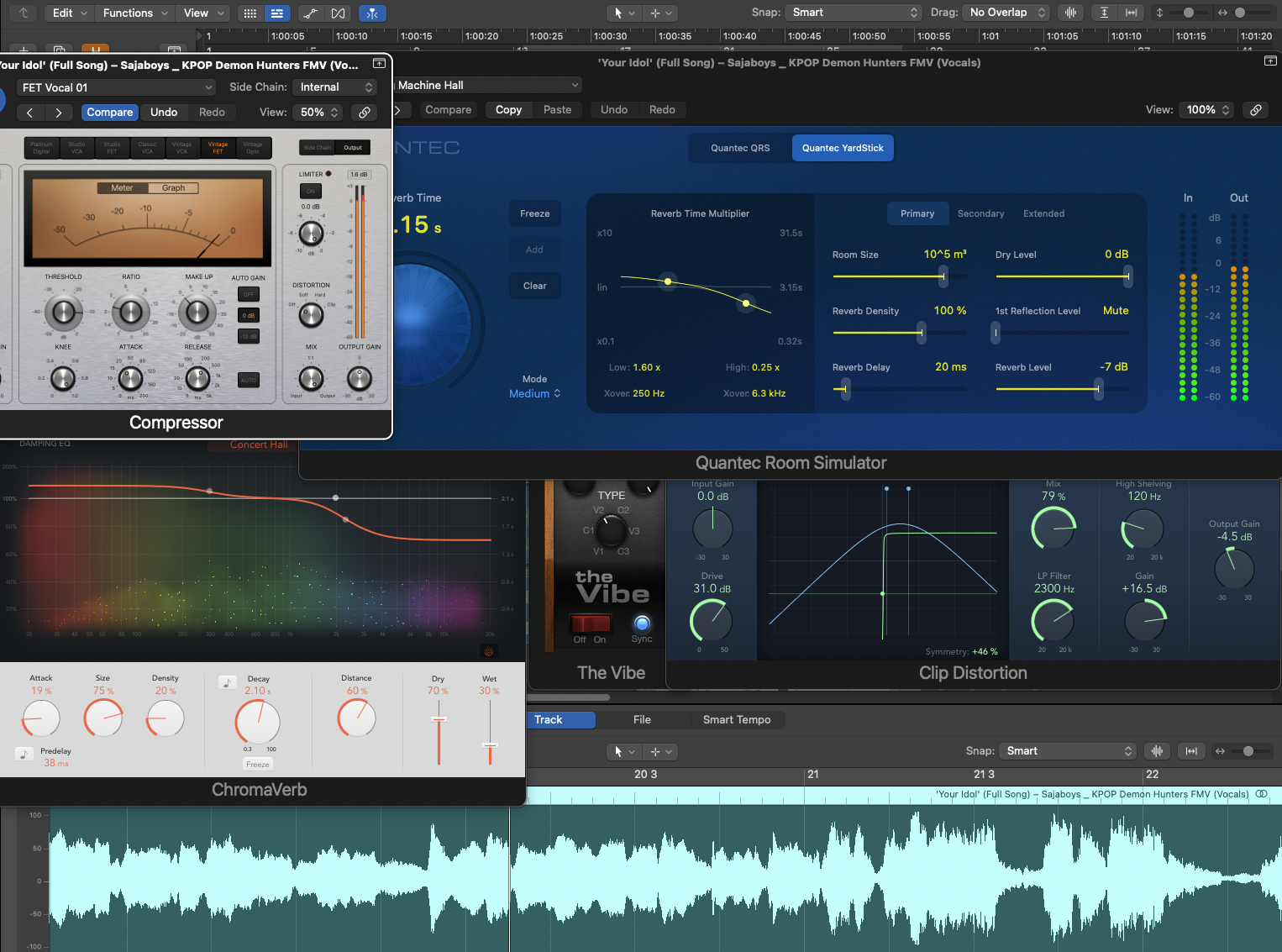
I took ‘Your Idol’ by Saja Boys—yeah, the ones from K-pop Demon Hunters—and gave it a proper “Industrial Garage” makeover. I wanted sharp, biting guitars and heavy, concert-hall drums, none of those thin EDM textures. I went all out with the Quantec Room Simulator and ChromaVerb to create a massive sense of space, then used Clip Distortion to properly crush the sound grains for that raw, gritty finish.
Caption: A 30-second comparison of the original track vs. my remastered Shoegaze version.
Soooooo, here we are. My poor guitar/bass/drum plays sprinkled top of EQ-edits a bit, thanks to Logic Pro’s massive plug-in sets to trim my shit playing part. That’s how re-master version is made. Tadaaaa. Now I can enjoy listening to this and imagine to be in the concert hall with live session band behind.
Quantec Room Simulator & ChromaVerb: I used the Machine Hall preset to recreate those massive concert hall reflections. I cranked the Reverb Time and bumped up the Room Size so the sound would bleed out in every direction.
FET Compressor & Clip Distortion: I slapped the FET Compressor on the vocals and instruments to glue the whole sound together, then used Clip Distortion to slightly crush the edges for that gritty, signature garage band vibe.
To be honest, I’m not a music major and my music theory is pretty shaky. I only ended up down this rabbit hole because I was obsessed with those drum and bass rhythm games. Rather than memorising theory till I’m blue in the face, I’ve always been the type of learner who needs to write the code, break stuff, smash it together, and rebuild it—and I reckon that exact approach is baked into how I produce now.
My guitar playing is absolute rubbish, but Logic Pro’s massive plug-in sets covered for my shit playing and made it sound decent. Now I’ve got my own remastered versions on my phone where a live session band is absolutely killing it right behind me. Seriously, this is why I love arranging—it’s a bloody ripper feeling!
PS - By the way, this is only for my private use. So this re-mastered version only plays on my personal device.